




Exploring protein biophysics with B2BTools and Scop3P

Exploring protein biophysics with B2BTools and Scop3P
to be announced
General context
Protein function depends on dynamics - not just static structures. While AlphaFold2 revolutionized structural biology by predicting near-complete protein structures, its models provide only a single snapshot. This course introduces tools that go further by exploring sequence-based biophysical properties such as disorder, dynamics, and folding propensity.
You will learn how to use B2BTools to predict these features and Scop3P to assess the structural and functional impact of phosphorylation sites. By combining structural predictions with dynamics insights, you will gain a deeper understanding of protein flexibility and function. Both tools are developed and maintained by the ELIXIR Belgium node, making them freely accessible for academics users.
- Calculate and analyse protein biophysical profiles for sequence-based data.
- Perform exploratory structural analysis combining the AlphaFold predictions with biophysical profiles generated by the B2BTools
- Compare the impact on protein dynamics by introducing mutations with B2BTools
- Correlate biophysical properties to post-translational modifications (PTMs)
This course includes practical, hands-on exercises. You need to bring your own laptop and have an active Google account, as all analyses will be performed on the Google Colab platform using Jupyter Notebooks.
- Basic knowledge of proteins and protein structures is an advantage.
- Python skills are recommended but not mandatory to follow the Google Colab Jupyter Notebook exercises
- B2BTools: Online predictors for biophysical features (Bio2Byte platform)
- Scop3P: PTM database with web interface and REST API (CompOmics platform)
- Google Colab: Jupyter Notebooks for running workflows
This course is part of the learning path Structural biology.
AI methods used
This course uses sequence-based predictive models embedded in tools such as B2BTools to infer protein biophysical properties (e.g., disorder, dynamics, folding propensity) directly from amino acid sequences. These predictors rely on machine learning approaches trained on experimental data to identify patterns linking sequence to structural and functional features.
Trainers
Adrián Díaz
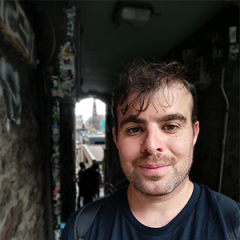
Adrián joined the Bio2Byte lab at the Vrije Universiteit Brussel (VUB), led by Prof. Dr. Wim Vranken, in 2021 as a Scientific Collaborator. He focuses on research software development and deployment, and has contributed to several technical projects, including the infrastructure supporting the lab’s ELIXIR Belgium node services: B2BTools and the Biophysical Proteome Atlas.
He holds an Engineering degree in Systems Engineering (FRBA-UTN, Argentina) and an MSc in Bioinformatics (UNQ, Argentina). Before joining the Bio2Byte lab, he spent over ten years working in software engineering in Buenos Aires, Argentina.
Pathmanaban Ramasamy

I did my masters in Bioinformatics at Saarland University, Germany where I worked on detecting the protein similarity of fast evolving viral proteins using graph mining approach.
In 2016, I joined the CompOmics group and IB2 as a joint PhD student between Prof. Lennart Martens (Ghent University) and Prof. Wim Vranken (Vrije Universiteit Brussel) to work on the FoldMod project, where we try to understand the role of local amino acid interactions in protein folding, fold stability and the location of post-translational modifications. I apply my knowledge on structural bioinformatics and proteomics informatics to understand protein phosphorylation.
Program
Introduction
- Opening words and initial setup
- Introducing the biological context (human proteins of interest)
Biological profiles (B2BTools node service)
- Running the B2BTools predictors using the official website
- Understanding the results as biological profiles
- Coffee break (10’ to 15’) by 10:30
- Introducing mutations to compare the impact in the structure dynamics
- Closing morning block
Lunch (provided)
PTMs (Scop3P node service)
- Introducing Scop3P and hands-on experience on using web interface and/or Notebook utilities
- Coffee break (10’ to 15’) by 15:00
- Combining PTM annotation with biophysical properties from B2Btools
- Closing afternoon block
Closing remarks
- Wrapping up
- Take-home messages