




Introduction to Computational Protein Design - September 2024

Introduction to Computational Protein Design - September 2024
11 & 12 September
General context
The 2-days training session will provide an overview of the principles of computational protein design and of the state-of-the-art tools used to design proteins.
Day 1 will start with a hands-on exercise to predict the effect of point mutations on protein stability using Rosetta. We will use a few example to demonstrate how to prepare the input PDB structure and how to run computational site saturation mutagenesis to search for mutations stabilizing the protein. In addition to using command line interface (on the VSC VUB clusters), we will introduce and test the PROSS automate server. The afternoon of Day 1 will be dedicated to building protein fusions and chimeras using the DirectSegmentLookup application in Rosetta. In that context, elements of design using symmetric constraints will be introduced.
Day 2 is dedicated to de novo protein design. After a brief introduction of the principles and theoretical background, several hands-on exercises will be proposed to learn the basis of protein design with RFDiffusion and ProteinMPNN. To get the most from this training session, the trainees should be able to visualize protein structure (with Chimera or Pymol) and to use AlphaFold2 and ColabFold.
Day 1:
- Recall the steps to prepare an input PDB structure for Rosetta and outline the process of computational site saturation mutagenesis
- Explain the principles behind the effect of point mutations on protein stability and the use of the PROSS automated server
- Perform hands-on exercises to predict the stability of proteins with point mutations using Rosetta and the VSC VUB clusters
Day 2:
- Differentiate between the various methods of de novo protein design, such as RFDiffusion and ProteinMPNN
- Assess the theoretical principles of protein design and apply them to analyze protein structures using Chimera or Pymol.
- Design a novel protein using the principles learned and tools like AlphaFold2 and ColabFold, integrating feedback from hands-on exercises
You are encouraged to use your own laptop.
PROSS automate
RFDiffusion and ProteinMPNN
AlphaFold2/ColabFold
Trainers
Anastassia Andreevna Vorobieva
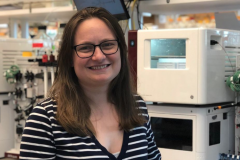
Anastassia is an assistant professor at VUB and a group leader at the VIB-VUB Center for Structural Biology. Her lab focuses on the de novo design of membrane proteins, and in particular transmembrane beta-barrel nanopores. After obtaining a PhD from UCLouvain, she spent 5 years as a postdoctoral researcher in the laboratory of David Baker at the University of Washington (Seattle) and the Howard Hughes Medical Institute. She also worked in the immunoengineering lab of Bruno Correia at the EPFL (Lausanne, Switzerland).
Thomas Guiziou
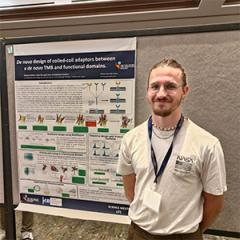
Thomas is a PhD student at the VIB-VUB Center for structural Biology. He uses Rosetta, RFDiffusion and ProteinMPNN to design new nanopores for the sensing of small molecule metabolites.
Andrei Sokolovskii
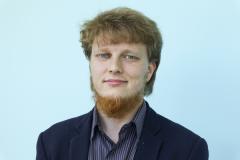
Andrei is a second-year Ph.D. student at the VIB-VIB Center for Structural Biology, where he is involved in the development of an inverse protein folding machine learning approach based on graph neural networks. In addition, he uses Rosetta and GROMACS molecular dynamics simulation results to predict the stability of single-point protein mutations.
Program
9:30h Prepare a protein structure for design
Predict the effect of mutations with Rosetta DDG
Linker design (DirectSegmentLookup and hallucination)
17:00h End of the course
9:30h Principles of de novo design
Building a backbone with RFDiffusion
Sequence design with ProteinMPNN
17:00 End of the day
Practical info


11 September 2024 - 12 September 2024
Brussels - VUB Campus Etterbeek
Pleinlaan 2
1050 Brussels
Belgium
11 September 2024 - 12 September 2024
Brussels - VUB Campus Etterbeek
The campus is well served by metro, tram and buses of MIVB and De Lijn. An overview of stops around the campus can be found on the access plan.
Plan your route with the planner of MIVB and De Lijn.
The campus is easily accessible by train. Etterbeek and Delta train stations are within walking distance. From Brussels Central Station, in addition to the train to Etterbeek station, you can also take metro line 5 to Pétillon stop or cycle 5 km to the campus. You can plan your trip to VUB with the NMBS route planner.
11 September 2024 - 12 September 2024
Brussels - VUB Campus Etterbeek
Brussels is building a network of cycling routes so that cyclists can get around safely. You can use the Brussels Route Planner to find the fastest or safest cycling route in Brussels. To commute easily from Flanders, you can use the Cycle Highways.
On the Campus Map, you will find an overview of bike tracks spread across the campus. At Student Information (Building D) you find the largest bike parking. There are several Villo! Stations around the campus where you can take a bike with a subscription or ticket and return it to another Villo! Station of your choice.
Here you can find more information on cycling to VUB and in Brussels.
11 September 2024 - 12 September 2024
Brussels - VUB Campus Etterbeek
Plan your route via maps.
Visitors can request access by car via this link. Enter the campus via entrance 6 on Triomflaan and park in the underground car park under building I.
Low Emission Zone: The campus is located in the low emission zone (LEZ) of Brussels Capital Region (BCR). If you come by car, check whether your car is allowed to drive in the LEZ. If your car doesn't meet the access criteria for the LEZ, then you can buy a day pass. Cars registered abroad must register for the LEZ unless they are registered in The Netherlands.
11 September 2024 - 12 September 2024
Brussels - VUB Campus Etterbeek
Room E.2.03